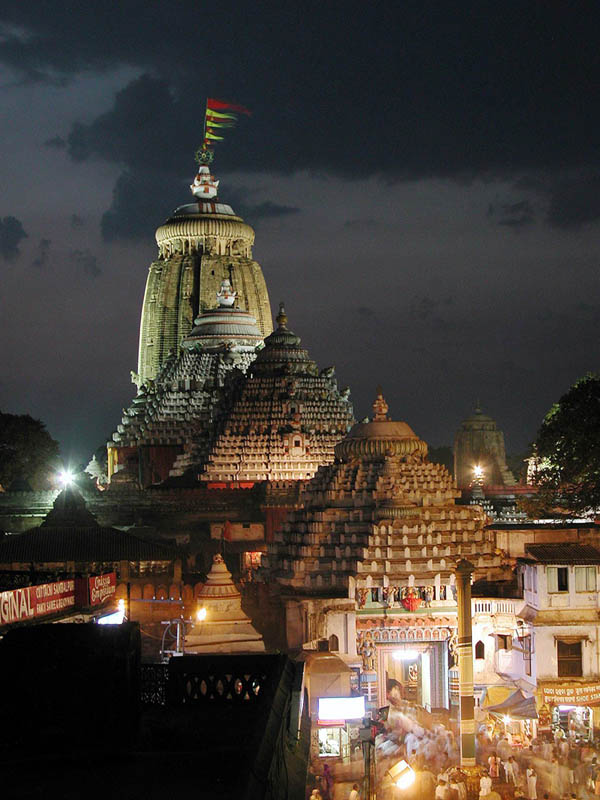
Jagannath Temple, Puri
About the Temple
The Jagannath Temple is a Hindu temple dedicated to Jagannath, a form of Vishnu. It is located in Puri, Odisha, on the eastern coast of India. As per temple records, King Indradyumna of Avanti built the main temple. The present temple complex was rebuilt from the eleventh century onwards on the site of the earlier shrines, excluding the main Jagannath temple, and was begun by Anantavarman Chodaganga, the first ruler of the Eastern Ganga dynasty. Many of the temple rituals are based on Shabari Tantras which are evolved from tribal beliefs respectively. The local legends link the idols with Nilamadhaba deva worshipped by tribala and the daitapatis (servitors) claim to be descendants of the tribes. The temple is one of the 108 Abhimana Kshethram of the Sri Vaishnavite tradition.
- Kalinga architecture
Sacred History
"Early shrine Literary and epigraphic evidence indicates that the site of present-day Puri (also known in early sources as Purusottama Kshetra or Nilachala) had religious significance prior to the construction of the current Jagannath temple by Anantavarman Chodaganga Deva in the 12th century CE. The Skanda Purana's Utkal Khanda has a dedicated section to Puri called the "Purushottama Kshetra Mahatmya", while the Narada Purana and Matsya Purana also refer to Purusottama Kshetra as a sacred location dedicated to Vishnu. The Prabodha Chandrodaya Nataka (c. 11th century CE) of Krishna Mishra also mentions a devayatana (temple or shrine) of Purusottama, indicating an established shrine before the Ganga period. Traditional accounts also record the visit of Adi Shankaracharya to Puri in the 8th-9th century CE, during which he established the Govardhana Matha, further supporting the presence of an active pilgrimage centre before the 12th century architectural phase. Ancient and medieval period The earliest major reconstruction of the Jagannath Temple complex at Puri is attributed to Anantavarman Chodaganga of the Eastern Ganga dynasty, who ruled c. 1078-1150 CE and established the foundational structure of the present temple around the early 12th century. This is supported by the Kendupatna copper-plate inscription of his descendant, Narasingha Deva I, and inscriptions from Rajendra Chola's maternal side. Anantavarman was originally a Shaivite, and became a Vaishnavite sometime after he conquered the Utkala region, in which the temple is located, in 1112 CE. A 1134–1135 CE inscription records his donation to the temple. Therefore, the temple construction must have started sometime after 1112 CE. Anantavarman's successor Anangabhima Deva III (r. c. 1211-1238 CE) formally dedicated the kingdom of Utkala to Jagannath and issued copper-plate inscriptions describing himself as the Rauta (servant) of the deity rather than a sovereign ruler. During the 15th-16th centuries, the Gajapati kings of Odisha, such as Kapilendra Deva and his successors, institutionalised the temple as a major state-supported religious centre under the Gajapati monarchy. Afghan invasion and restoration In 1568 CE, following the defeat of the Gajapati ruler Mukunda Deva, the Afghan general Kalapahar invaded Puri and attacked the Jagannath Temple. The Madala Panji and regional chronicles state that the temple treasury was looted and the wooden images of Jagannath, Balabhadra, and Subhadra were desecrated. The images were removed from the temple, discovered by Kalapahar, and burned. Temple traditions state that Bisara Mohanty recovered the Brahma Padartha of the damaged image of Jagannath and preserved it in a mridanga (drum) after the attack. During the late 16th century, Ramachandra Deva I of Khurda re-established the Jagannath temple and commissioned new wooden images for worship. The deities were reinstalled at Puri in 1575 CE, marking the first ritual of Nabakalevara. Mughal rule During Mughal rule, the temple continued to face periodic attacks, military occupations, and heavy political pressure. Governors and military commanders such as Mirza Khurram, Hashim Khan, Kesodas Maru, Kalyan Mal, Mukarram Khan, and later officials under Aurangzeb launched raids on Puri during the 17th century. The temple annals, the Madala Panji, records that the Jagannath temple has been invaded and plundered 18 times. Temple wealth was repeatedly plundered, and the deities were frequently moved by servitors to locations around Chilika, Khorddha, Banpur, Kodala, and other regions for protection. The temple has been attacked 18 times British colonial rule Following the British conquest of Odisha in 1803, the East India Company assumed control of the Jagannath Temple's administration. Regulation IV of 1806 placed the temple under a board of government-appointed Brahmins. In 1809, this arrangement was replaced by hereditary supervision under the Raja of Khorddha and his successors. The British continued the Maratha-era pilgrim tax, classifying pilgrims according to their financial status while exempting ascetics and the poor. Revenue from the tax funded temple expenses, repairs, and pilgrimage infrastructure, including improvements to the road between Puri and Calcutta. Between 1805 and 1827, annual collections averaged approximately one lakh rupees. Missionary criticism of temple administration The temple's administration became the subject of controversy in Britain. Christian missionaries and religious organisations argued that government management of a Hindu temple and the collection of pilgrim taxes amounted to official support for "idolatry". Petitions submitted to the British Parliament and the Court of Directors called for the termination of state involvement in temple affairs. In response, the Court of Directors issued a dispatch in 1833 directing that British interference in the management of religious institutions should cease. The pilgrim tax was subsequently abolished under Act 10 of 1840. Although the Raja of Khorddha retained responsibility for the temple's internal administration, the government continued till 1863 to provide financial support and oversee certain temple lands. The Jagannath Temple thereafter remained under indigenous management for the remainder of the colonial period. Post Independence Following Indian independence in 1947, the administration of the Jagannath Temple was reorganised under state legislation. The Puri Shri Jagannath Temple (Administration) Act, 1952 initiated the documentation of temple rights and customs, while the Shri Jagannath Temple Act, 1955 established a formal management system for the temple. The Act came into force on 27 October 1960 and vested administration in the Shri Jagannath Temple Managing Committee, headed by the Gajapati Maharaja of Puri. Amended in 1983, the Act remains the principal legal framework governing the temple's administration and property."