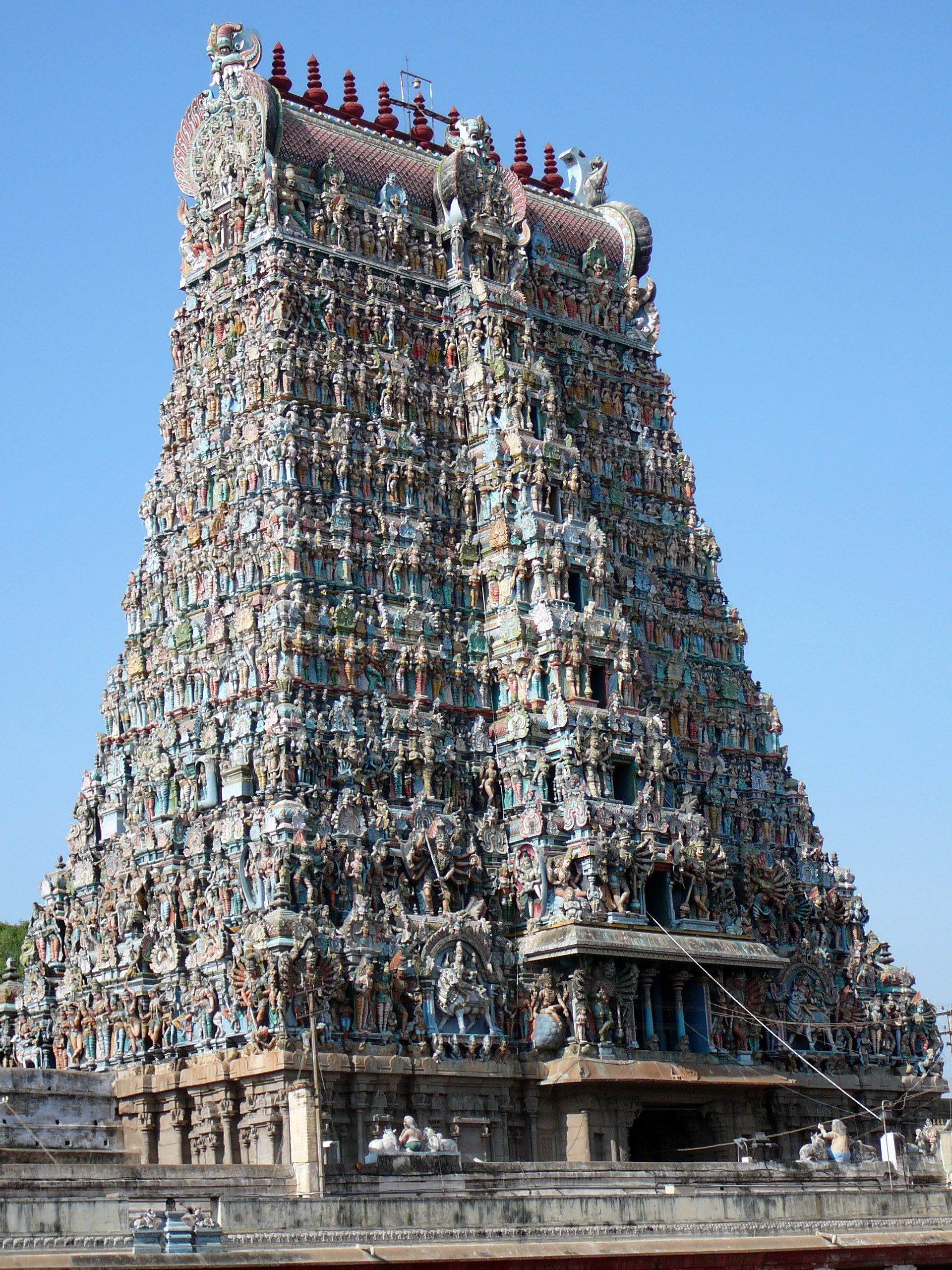
Meenakshi Temple
About the Temple
Meenakshi Temple, also known as Meenakshi Sundareswarar Temple, is a historic Hindu temple located on the southern bank of the Vaigai River in Madurai, Tamil Nadu, India. It is dedicated to Meenakshi, a form of Parvati, and her consort Sundareswarar (Shiva). The temple is theologically significant as it represents a confluence of various denominations of Hinduism such as Shaivism, Shaktism, and Vaishnavism.
Sacred History
"Early history (before 12th century CE) The town of Madurai is described from the Sangam era texts, dated to 1st to 4th century CE. Tamil texts imply that a temple existed in Madurai by the mid-6th century. As per these texts, the town of "Koodal" (Madurai) is described as a temple town where every street radiated from the temple. In the Teveram texts, the temple and its deity are referred to by various epithets and names. In Campantar describes the deity as Aalavaai Iraivan. In early medieval literature and inscriptions, it is sometimes referred to as Kadambavanam as the region was covered with Kadamba trees. Various descriptions and mythology associated with the temple are described in regional texts and literature, which are often centered around a warrior goddess, but the details vary significantly and are inconsistent with each other. Hence, scholars have attempted to determine the history of the temple from the inscriptions and records relating to South Indian dynasties. However, most of these are dated to post 12th century CE. During the rule of the Pandya dynasty, goddess Meenakshi is described as the divine ruler of Madurai, who along with Shiva were revered as the primary deities. The earliest of the existing masonry of the Meenakshi temple was built during the reign of the Pandya emperor Sadayavarman Kulasekaran I (r. 1190–1216). The gopuram at the entrance of the Sundareswarar shrine and the central portion of the Meenakshi shrine were built during his reign. Texts and inscriptions also credit him with building shrines for Nataraja and Surya near the main sanctum, Ayyanar in the east, Vinayagar in the south, Kariamal Perumal in the west and Kali in the north of the temple complex. The temple was later expanded during the reign of Maravarman Sundara Pandyan I (r. 1216–1238). During his reign, Ananda Nambi built the Vembathurar gopuram, and another large gopuram (named after Sundara Pandya) was added in 1231 CE. Maravarman Sundara Pandyan II (r. 1238–1251) added the Chitra gopuram in the west, a pillared corridor heading towards the Sundareswarar shrine, and a mandapa named after him. Destruction, restoration and expansion (14th century to 17th century CE) After the death of Maravarman Kulasekhara I in 1310 CE, his sons Vira Pandya IV and Sundara Pandya IV fought a war of succession for control of the Pandya empire. It coincided with the South Indian raids of the Khalji dynasty of the Delhi Sultanate. As per available records, Malik Kafur raided various towns and destroyed the Hindu temples including the Meenakshi temple, while looting them. He took back an enormous loot of gold and jewellery from the Pandya kingdom to Delhi in 1311 CE. The Islamic invasion brought an abrupt end to the patronage of the Hindu temples. After the conquest and destruction, a Muslim governor was named to rule Madurai, and later established the Madurai Sultanate. The Sultanate sought tributes from the temples, and caused further damage. The Vijayanagara Empire was established in early 14th century and succeeded in capturing Madurai in 1378 CE. According to Madhura Vijayam, Kumara Kampana was asked by his wife Gangadevi to liberate Madurai, and reopen the Meenakshi temple. According to the text Thirupanimalai, Kampana after completing his conquest of Madurai, rebuilt the temple structure and built defensive walls around the temple. The temple idols, which were hidden during the Sultanate rule, were brought back and reconsecrated in the temple. Though the Meenakshi temple existed earlier, most of the present masonry were rebuilt and added since the 14th century. The restoration of the temple took a while, and it was repaired and expanded along with other regional temples. The two gopurams located to the east and west of the Sundareswarar shrine were built in 1372 CE and 1374 CE respectively. The temple inscriptions suggest that the Vijayanagara rulers participated in the ceremonies of the temple and made grants to cover the expenses for daily operations of the temple. The Nayak commanders, who served under the Vijayanagara empire, expanded the temple further. In the mid 15th century CE, Lakana Nayak added the defensive walls around the first prakara, and renovated the Mahamandapa and the Meenakshi shrine. He also built the Paliarai (bed chamber), where the icons of the gods symbolically spend the night. The Nataraja shrine was added in the late 15th century CE by Arulalan Sevahadevan Vanathirayan, who also renovated the Thiruvalavaiudaiyar shrine. In 1516 CE, Saluvanarasana Nayak constructed the sacred pool named Ezhukadal (seven seas). Chinnappa Nayak constructed the Nayaka mandapa in 1526 CE. Chettiappa Nayak rebuilt the Dvarapala mandapa in front of the Sannadhi gopuram, the north colonnade of the golden lotus tank, and added a second protective wall around the Meenakshi shrine. The temple was further renovated and expanded in the 16th and 17th centuries by the Madurai Nayaks. During the reign of Vishwanatha Nayak (r. 1529–1564), the temple complex was further fortified and the vimana above the Meenakshi shrine was gilded with gold. Under the supervision his prime minister Ariyanatha Mudaliar, more towers and various sculpted pillared halls, including the thousand pillared hall, were added. The Nayaka gopuram in the second prakara was built in 1530 CE, while the Palahai gopuram was added later. The Kadaka gopuram in Meenakshi's shrine was built around the mid 16th century CE. The granite structures of the various gopuras were renovated by Kumara Krishnappa Nayak (r. 1564–1572). The Murthiyamman and Nandi mandapas were also added during his reign. The south gopuram, the tallest tower, was built in the late 16th century CE. The Mottai gopuram ("bald" gateway) was started during the reign of Krishnappa Nayak (r. 1572–1595), but was not completed till 1878 CE. The Murugan shrine in the north east corner of the second prakara, the Kambathadi and golu mandapas were added during his reign. The Vira vasa"


